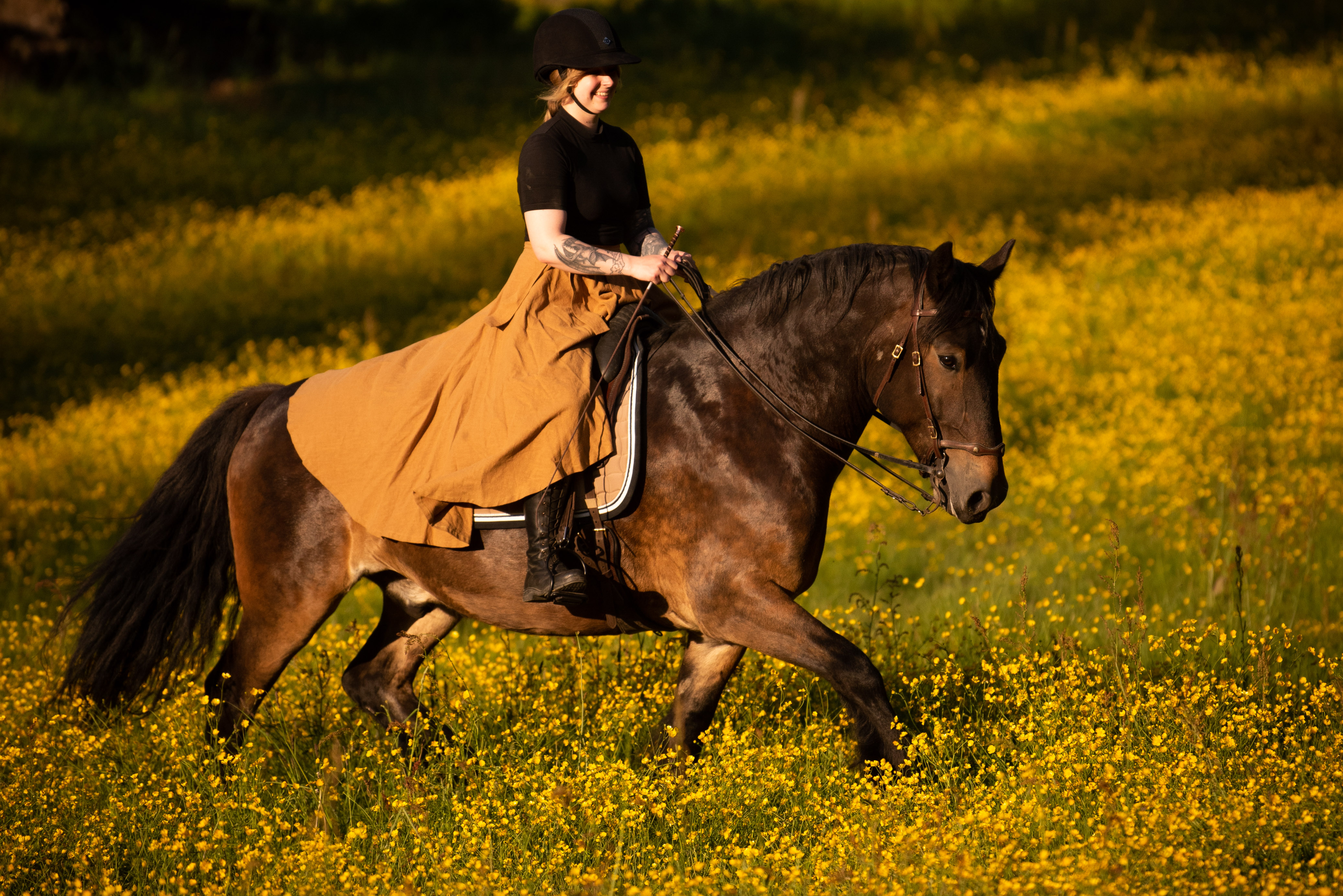
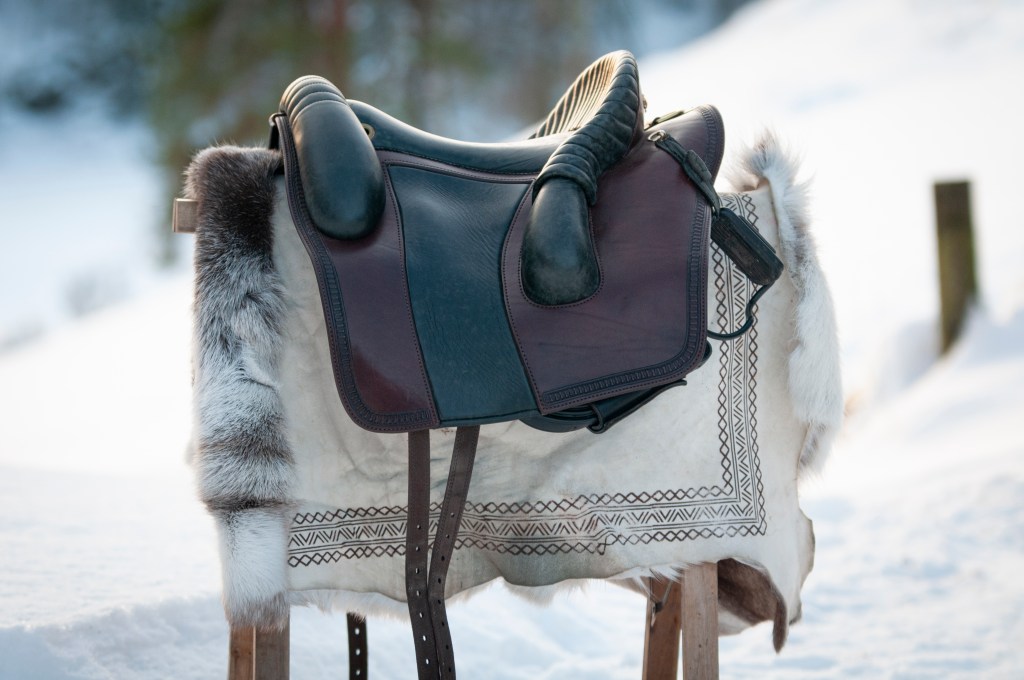
One of my most commonly asked questions: Why do I have a fur under my saddle? So here’s why, along with the 18 FAQ’s that tends to come as follow-up questions!
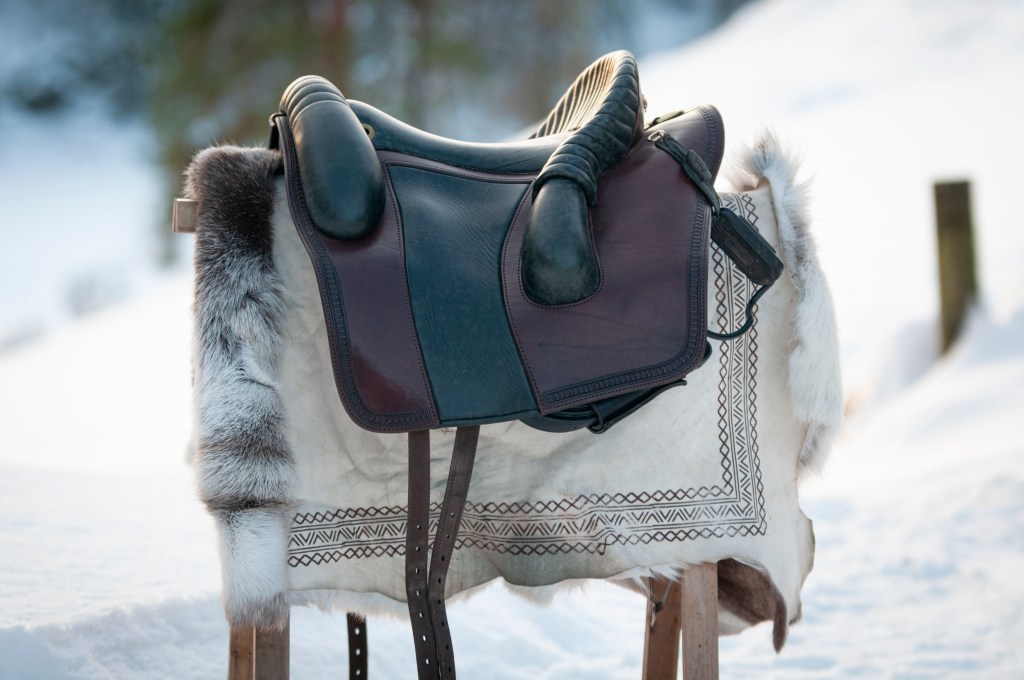
I have found two different sources for the reindeer saddle pad studies, the one I’m referencing in this blog was the original I found with a too wide saddle (link to study).
While it’s a small study, there are a lot of interesting information in there. The most interesting to me is this part: The saddle pressure and maximum overall force (MOF) showed significant intra-horse effects. At walk, the foam and gel pads significantly reduced the MOF in 44.4% of cases, whereas at the trot, the gel and reindeer-fur pads significantly reduced MOF in 61.1% of subjects.
The horses in the study was fitted with an excessively wide saddle. If your saddle isn’t too wide, this might not be a good option for you, and they also point out how gel pads reduced the maxiumum overall force too. I have not been able to find any details on which gel pad they used, which I bet is of some pretty big signifigance, but if you’re keen to know I’m sure you can reach out to the team.
While the study was performed using MOF as a measurement, there are plenty other features it would have been interesting to test – such as temperature distrubution, breathability, sustainability and so on. There are some good theories as to why the reindeer fur shows such good results, so let’s walk through some of them.
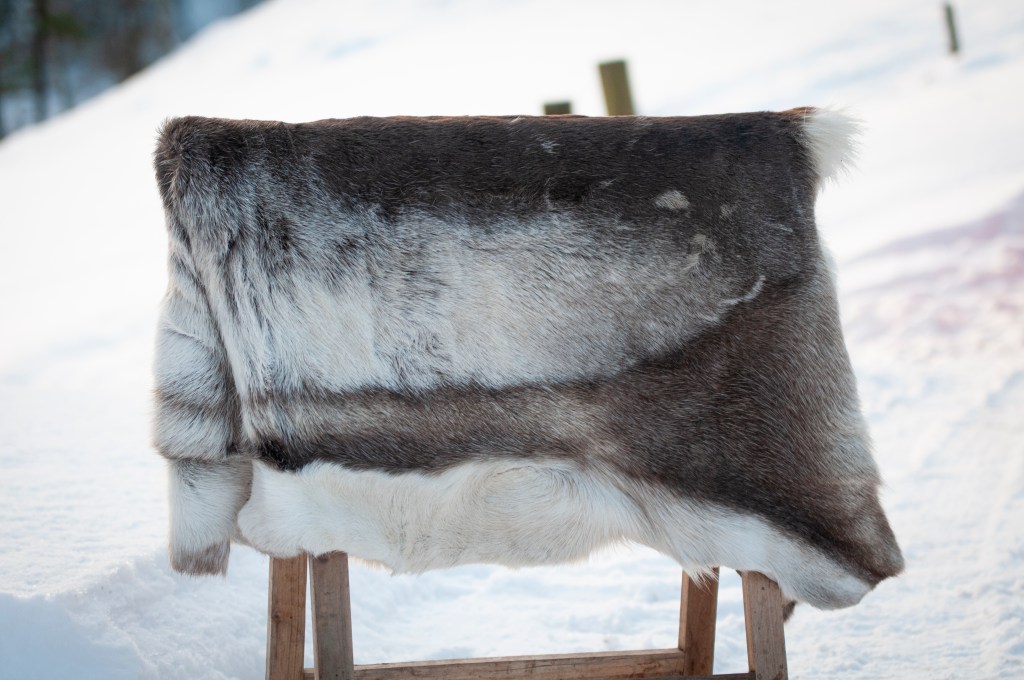
I found this link at a later point which suggests there a study done with a normal fitting saddle too (another link to another source), which seems to suggest reindeer still was a good choice: “Only the reindeer fur pad significantly decreased the MOF…”.
It seems to be the same authors, with one published in February of 2010 and one in June the same year. I am curious why they chose to not test a sheepskin pad, as they are quite common too, but I’m sure they had their reasons.
Reindeer hairs are hollow. This sets them apart from most other animals we could use as a furry substitute. I’m sure this has a nice name in English that I have yet to find, but the Norwegian name for it is “rørhårsdyr” (pipe hair animals), so there’s another fun fact for the day.
These hollow hairs give us some pretty unique features. Not only do they work very interestingly when warmed up, in distributing and keeping the heat, but as the hairs lay in one direction (compared to a sheep pad, which is curlier), it helps the excess heat travel somewhere. This prevents over-heating.
Many accustomed hikers in the Nordics know very well that if you are to sleep outside in the cold; you sleep on top of a reindeer skin, and underneath a sheepskin, because the reindeer is better for your back, and the hollow hairs heat up underneath you, keeping you at a comfortable temperature.
While all of this is pretty exciting, let’s get to the reason why you’re all here: the FAQ.
Where do you get the reindeer furs from?
I buy mine from Skinnlåven, my “local” leather supplier. They have some great 2nd sortment furs, that have some cosmetic errors, that come at a cheaper price. They do ship within Norway (just tell them it’s for a horse saddle pad and they’ll find you a good one), or you can do to their store in Hønefoss.
Can I get one outside of the nordics?
As a born and bred Norwegian, I sadly have a limited understanding of the international reindeer market. What I do know is that because reindeers aren’t all that common, many countries have a special permission thing you need to import the furs. Usually his isn’t too advanced stuff, and I would encourage you to go down the Google-y route of finding out.
I do know that reindeer furs are somewhat common in nordic themed gift shops, but the ones I’ve seen and worked with has been coated with some sort of waterproof chemical, making them both stiff and slippery, which isn’t ideal.
How do you pick out a good fur?
Even the bigger furs look small once on horseback and underneath a saddle. My experience is that the bigger the fur, the thicker the skin, and the thicker the fur too – and this is what’s tricky with these natural products. I try to find a nice middle way between big enough, and “thin” enough.
I’m not as worried about thick fur as I am worried about the skin itself being thick and stiff. The furs I use are tanned with alum, one of the oldest tanning techniques, but I do know some people use dried furs. I think some of the dried furs look wrinkly and a bit hard, but for all I know they soften and shape themselves nicely when warmed up.

Are reindeer saddle pads common in Norway?
Not really. It’s usually only seen in a bit more “alternative” communities, where you won’t be bullied for looking a bit different. That being said, there has been quite a few experiments with reindeer half pads in more common “english” stables, with generally good results and positive feedback. I know several traditional english riders who really swear by it.
Where can I find ethically sourced hides?
It would depend a lot on what you put into the term ethical. For some this term is about living and slaughter conditions (I’m not going to act delutional here, the reindeer fur was once a living animal, and we need to respect that), and for others there is no ethical way to slaughter an animal, so this question would cancel out itself.
There are only so many ways to keep reindeer, and the absolute majority here in Scandinavia is kept just like nature intended to – out in big herds, freely roaming the mountains. The reindeer keepers, usually nordic indeginous families, either move after the animals or cooperate with neighbouring families and take turns watching them. From what I know they are rounded up a few times a year. To me, this is about as ethical it gets. You can usually ask your supplier where the hide is from.
Do you prep the fur before use?
Since I buy a whole reindeer, and I don’t need a whole reindeer, I cut the front off. Depending on the size of the animal, it could be only the neck, or it could be the shoulders too. Apart from this, I don’t do anything else with it. I prefer to have some extra space in front, so I can fold it over slightly to show off the fur, but only because I think it looks cool. It serves no other purpose.
How do you put it on?
Fur against fur, tail towards tail. That way, the reindeer hairs stay calm against the horse fur, and you won’t experience rubbing. I find this to be the most logcial, as most animals have slightly thicker skin over their spine. Having it sideways would mean the thicker spine would lay across the horseback, under the saddle, and I imaigne that would create more preassure points.

Does it fill up and close the gullet?
Since Brego is a draft horse he has a thick spine, and I have saddle with a very wide gullet to fit him. I have not had any issues with the fur adding pressure on his spine. Is simply grab the fur and lift it up into the gullet, as I do with my normal saddle pads, and it stays up nicely throughout the ride.
Does it slip?
I have not expeirenced slipping. I’ve found that the skin on the hide grabs nicely to the panels underneath the saddle. Since I fold up the front part of the fur too, I do think this helps in keeping the pad in place.
What saddles does it fit underneath?
All saddles with flocking! I am no western rider, and I have limited knowledge about westenr sadles, but I have some experience with western saddle pads after working some years in a tack shop. Based on how those pads felt, quite rigid and firm, I would think that reindeer furs are not a good alternative for western saddles. The furs are not the same width across, nor are they the same thickness front to back.
Remember that the horses in the study had too wide saddles, so if your saddle is a little narrow or just perfect in width, a thick fur underneath might not yield the results you want.
Do you use it during summer?
Not on the warmest days. While it does a good job at transporting heat away from the horseback, it does have its limits. During summer I tend to wear thinner saddle pads, in materials which are slightly more breathable.
Do I need the whole fur?
No! Many english riders have experiemented with cutting out a smaller piece, similar to the “standard” wool half pad, and found very satisfying results. I enjoy the natural shape of the hide, but others want it more square for a tidier look.

How do I clean it?
It’s very important that the pad is left to air out if your horse broke a sweat, or it was raining. Do not leave it hanging underneath the saddle on the rack – this is an organic product and moisture will slowly break it down. Hang it out in the wind, give it a bit of a brush with your horse brush if needed, and it’ll be good to go.
Another common way of cleaning it, is to take it out into (dry) snow, and rub it around in the cold. Get some snow in-between the hairs, leave it for a while, shake well and hang to dry indoor.
How long does it last?
As it’s an animal product, being used and abused, you might have to look into replacing it after a while. How often depends on your horse, your riding conditions, of often it’s used, how it’s stored etc. Mine usually lives for 2 years before they get flatter than they once were.
My reindeer fur sheds a lot. Why?
This could be for a few different reasons. It could be due to when the animal was slaughtered, if it was starting to shed and so on. It could be due to the tanning process damaging the hairs, but most likely it is because the reindeer hairs are hollow. This means they are quite a lot more brittle than sheep furs. Excessive shedding is a little annoying, as you get reindeer hairs everywhere, but I’ve not found that it impacts the functionality of the pad itself.
Can I make it stop shedding?
Sadly, if a fur sheds it will continue to shed. It’ll go a bit bald eventually, unless the shedding is due to rough wear, in which you can try to treat it a bit more nicely.
Does your horse react to the smell/look of the pad?
I haven’t had any negative reactions yet. I always let them smell and investigate the fur, just to be sure. Once they are satisfied that it’s not alive, they don’t care. The tanning process also removes a lot of the natural scents.

Yes, but why do you use it?
I personally really enjoy the way it feels under the saddle, and I can feel a change in Brego when he wears it, compared to other saddle pads. It offers better weight distribution than normal fabric pads, looks super cool (to me, at least), Brego really seems to enjoy it, and truth be told, it’s a pretty good pad to put on wet fur – no need to wait for him to dry up.
Can you decorate it?
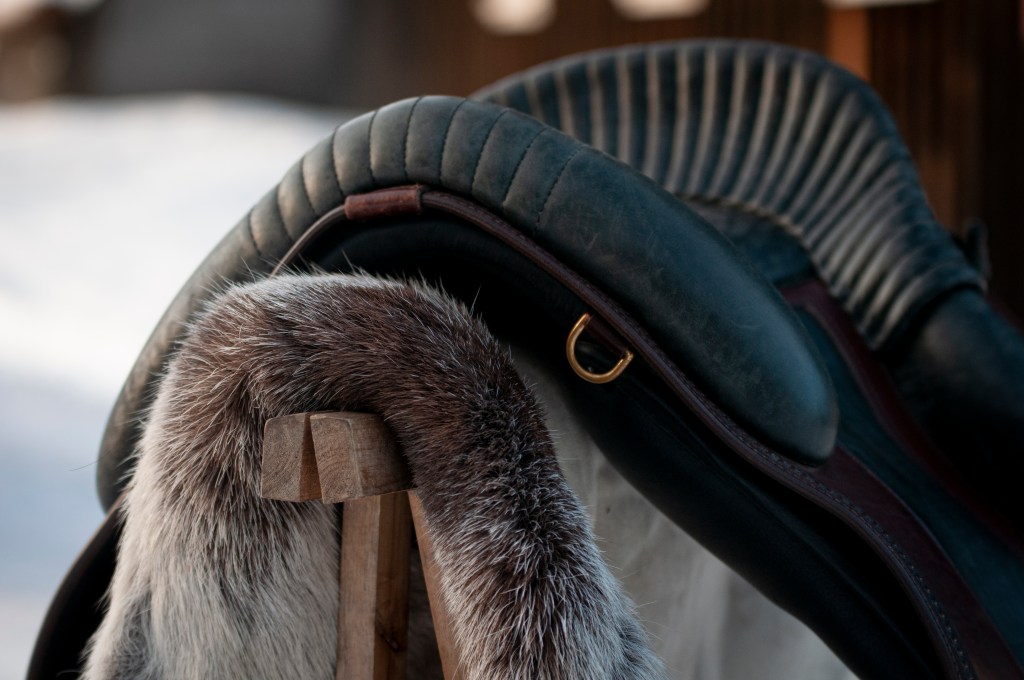
The reindeer fur I’ve added photos of here, has been hand stamped with a traditional norwegian technique. As long as the flesh side hasn’t been treated with something that would make the ink unable to stick, you should be able to have fun with textile paints for light textiles. You can’t iron the paint as is usually advised, but if you let it dry for at least two weeks, the paint will curate on its own.
Why not sheep fur? Or any other fur, for that matter..
Sheep hairs are not hollow, so they have an entirely different set of functions than reindeer. If I were to buy a whole sheepskin instead of a reindeer hide, I’d also struggle with matting. This matting could create pressure points down the line, so it’s a less sustainable option for this style of pad. The sheep products you purchase as halfpads etc, has been through a process to aid against matting.
As for other furs, goat hairs are (depending on the goat breed) thick and coarse, and a cow really doesn’t have that much hair. Moose skin + fur will be thicker than your entire saddle in total, roe deer has a rather thin layer of hair, boars are coarse and prickly. I would think in my head that caribou might be an option though, as they are basically the same animal as a reindeer -but don’t quote me on this, I have never even seen a caribou.
What are your views on the ethics of putting a dead animal on a living horse?
While the reindeer fur absolutely has a more rough dead animal “vibe”, my saddle and bridle is still made of a dead cow, and sheepskin pads are made of dead sheep. I am not going to pretend I don’t know this.
My view is that is respectful to utilise the entire animal when we are taking a life for our own use. The reindeer furs are a biproduct of the meat trade, which is important to the Samis: nordic indeginous people. I think it is great that we are able to use their wonderful furs like this. This is not for everyone, and I fully respect that. Disagreeing with me is perfectly okay.
PHEW that was a lot of questions
Leave some comments if you have more, and I’ll do my best to answer 🙂
// Emma and Brego


 Emma Wold
Leave a comment